
Here’s a littleon me.
I was born in India and grew up in southern California in a family with very little money that was working through hard things. What saved me was reading and believing in a brighter future.
Location
San Francisco
Family
Oliver, Soraya, Luka, Amara
Things I love
Books, films, walks, travel
Years rare-parenting
10

How I get inspired.
I was an only child, often lonely, sometimes bullied at school. I knew early that I wanted a different kind of life — not engulfed in sorrow and sadness.
What saved me was reading. I read history books, memoirs and fiction, looking for examples of people, especially women, who had built extraordinary lives from nothing, like the orphan-turned-entrepreneur Coco Chanel.
These books below have shaped my adult life.
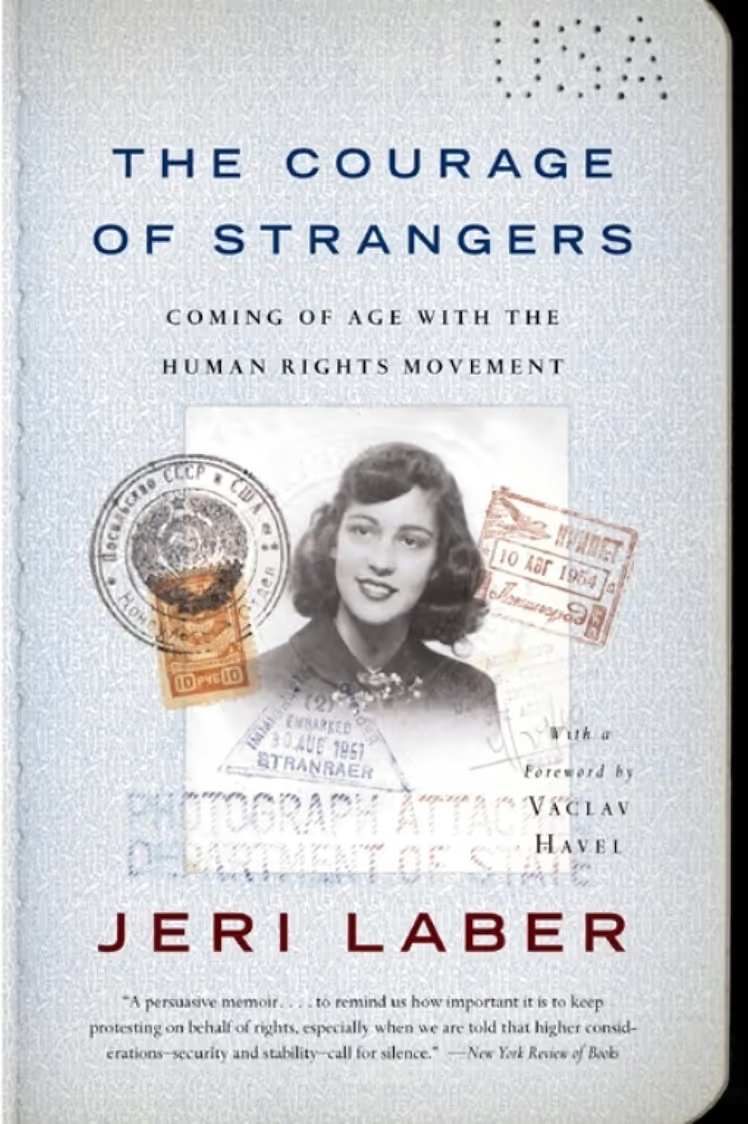
The Courage of Strangers
Jeri Laber

What Women Want
Patricia Ireland

Every Day Is a Gift
Tammy Duckworth
Three women who used their lives to make a difference.
The careers before this one
I keep choosing hard, societal problems.
Earlier years — Microsoft Multipoint Mouse, India
I have started three companies and worked at one of the largest in the world. The pattern, looking back, is that I keep choosing hard, societal problems.
My first job out of college was investment banking in New York. The city and the money were exciting, but within two years I knew it was not for me. I quit and moved to India to work for a non-profit, living in villages and small towns, working with women in Gujarat to scale their artisan work and with young people in Maharashtra on the skills they needed to find jobs. It was one of the best experiences of my life.
It also taught me that I did not want to work in finance or in economic development. I wanted to build products people needed, and make a sustainable business out of it.
So I built Fitter Solutions in India, an English and soft-skills training company. We trained five thousand people and I wrote a book that Penguin published. I learned my first hard lesson in business: not everything that works can scale.
I then came back to America for Harvard Business School, and from there moved to Seattle to work at Microsoft. The head of Microsoft India had told me about a research project where every child in an Indian village classroom was given a mouse to use with the sole computer. I became the product manager for that project, launching Mouse Mischief and Multipoint Mouse, and over five years went on to become Chief of Staff for the Education division and run the Innovative Schools program. Microsoft taught me how great product teams work — and how much harder it is to build a product that endures than one that just ships.
I left Microsoft pregnant with my second child, deeply interested in school choice in America and how invisible the data was. I started Schoolie, where we pulled records and built a tool for parents and policymakers showing what public schools actually offered. During this time my third child, Amara, was born, and I made the difficult decision to sell the company to GreatSchools and focus on my family. Selling Schoolie was the first time I had built something that could scale.
The turning point
Then Amara, and the world of rare disease.
After Amara was diagnosed with FOXG1 syndrome — a condition where she may never walk or talk, be severely intellectually delayed, and suffer from seizures — I was first in shock, then devastated. I spent months crying, full of self-pity, unable to face what was in front of me. The turning point came when I sat alone in the dark and let the pain and the grief flow through me. I came out hours later having decided I was not going to be a victim of my circumstances. It was time to do the thing I loved to do most: solve really hard problems.
What followed was building the FOXG1 Research Foundation with Nicole Johnson. We endured years of failures. Failed mouse models. Failed grants to Ivy League labs. Anxious parents who questioned what we were doing. Intense pressure to fundraise millions of dollars. I learned the science from scratch, and then six years later, we saw our mouse models completely rebuild their corpus callosum — the bridge between the left and right hemisphere in the brain, with our administered gene therapy. We then went on to innovate an entirely new way to develop an approved drug, from $1B to less than $25M, and are taking our first gene therapy to clinical trials.
During this time I also co-founded Citizen Health with Farid Vij because the data infrastructure we needed did not exist, and Citizen’s data became the foundation the FDA accepted for our clinical trial. In this last year, we have evolved Citizen to provide tools using AI to help caregivers and patients manage the intense day-to-day of having a rare condition.
Today Amara is ten. Looking back, none of this has really been for Amara. It has been because of her. I have asked the same question my whole life. Who says we cannot do this?
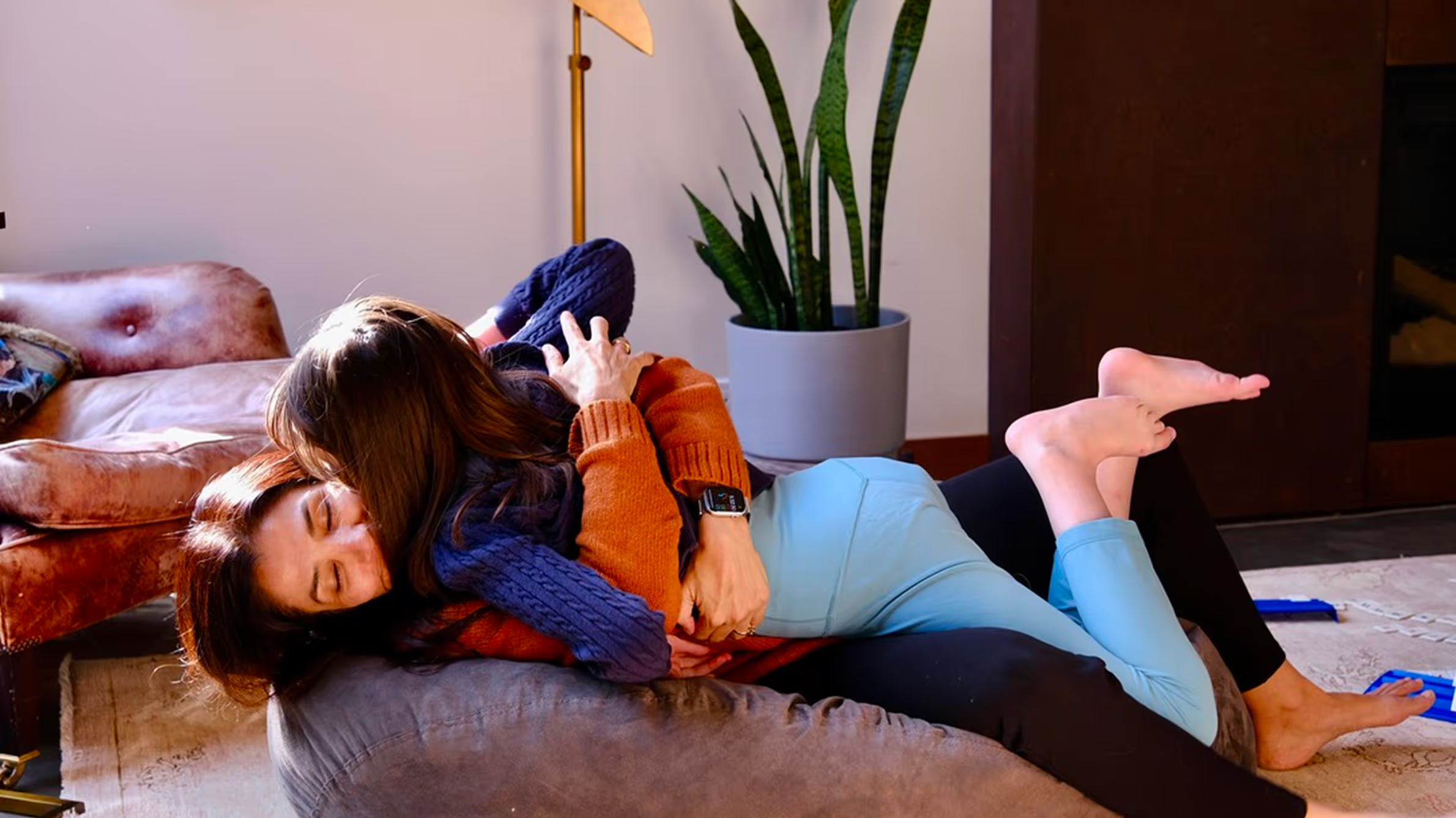
A day in our life
What life is like as a rare-disease mom and family.
Two short films from inside our house — what mornings, therapies, seizure days, and ordinary joy actually look like when one of your kids has FOXG1 syndrome.
Film 01
A day with Amara.
Film 02
Our family of five.
Outside of all this.
My friendships and my family are the center of my life alongside the work. I have built strong friendships across every stage of my life and I do not have superficial ones. The same is true of my marriage. My husband Oliver and I have an extraordinary partnership, and have built a home full of love, despite our challenges. My children Soraya and Luka are smart and hysterical, and so much fun to hang out with.
Amara is an exceptional child bringing us light, and teaching us all how to be more patient and compassionate.
Perhaps because my life is so hectic, my hobbies are calming. I read and watch films. I do tai chi and meditate. I drink tea with Luka in front of our fire. I do face masks with Soraya. I cuddle Amara. I walk the dog. On a good Saturday morning I am drinking coffee and reading the Weekender Substack, and that is just perfect.
One thing about my life and my leadership is working with partners. At home, it is Oliver. At the foundation, it’s Nicole. At Citizen, it’s Farid. I believe great things cannot be done alone, and finding and building relationships with the right partners is key.


Where I escape to.
I love being home. We have a beautiful garden with bamboo trees and it provides me with incredible peace.
I also love to travel. We travel as a family because I want our kids to see how much bigger the world is than any one place. The English countryside where Oliver is from is my happy place where things slow down. Mumbai, where I was born, is where I go for inspiration.
